
Patio & Interlocking in Toronto
Interlocking stone patios, walkways and retaining walls built on proper base prep.
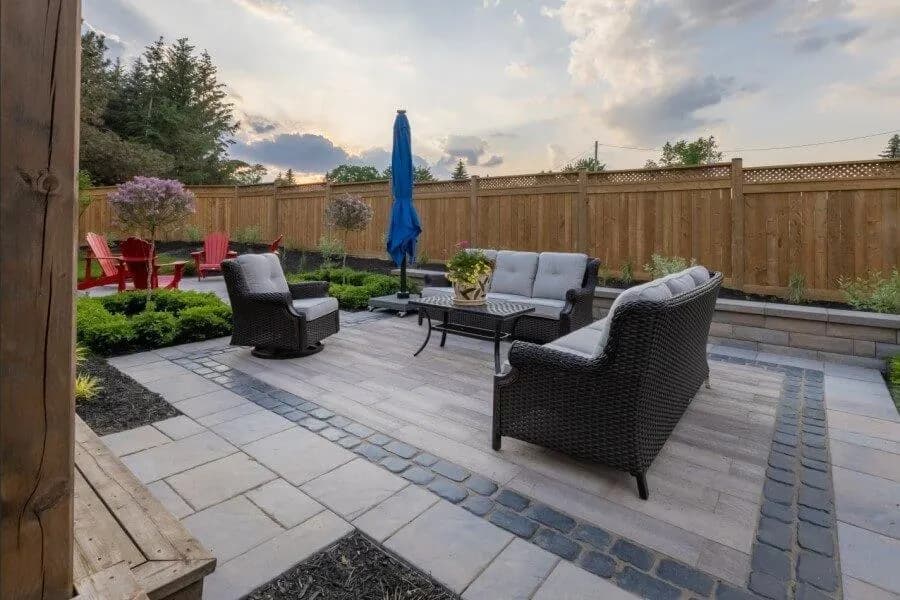
Overview
What a patio & interlocking project involves
Interlocking stone fails in one predictable way: it heaves and settles unevenly after a winter or two. That is almost never the stone's fault. It is the depth and compaction of the base underneath, which is exactly the part that is cheapest to skimp on and impossible to inspect once the job is finished.
We excavate to the depth the application requires, compact granular base in lifts rather than in one pass, and edge-restrain the perimeter so the field cannot spread. It is slower and it is why the surface stays flat.
What’s included
- Excavation to the depth the application requires
- Granular base installation compacted in controlled lifts
- Geotextile separation layer where soil conditions call for it
- Interlocking pavers, flagstone and natural stone
- Retaining walls and integrated steps
- Edge restraints and polymeric jointing sand
- Final compaction, sealing and site clean-up
Common questions
- Why did my last patio sink?
- Nearly always an inadequate base — too shallow, or compacted in a single lift so the lower material never consolidated. Freeze-thaw cycles then do the rest. It is the reason we quote base depth explicitly instead of leaving it unstated.
- How long does interlocking last?
- Properly based, decades. The pavers themselves outlive most other exterior surfaces, and because they are individual units, a damaged area can be lifted and reset rather than replaced wholesale.
- Does it need sealing?
- Not structurally. Sealing mainly resists staining and deepens the colour. If you want that look we will apply it, but we will not present it as necessary maintenance.